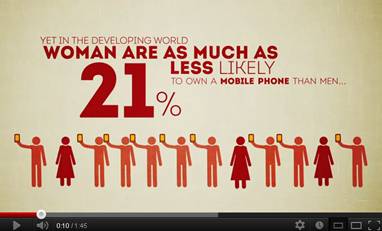
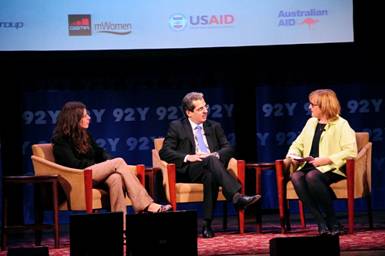
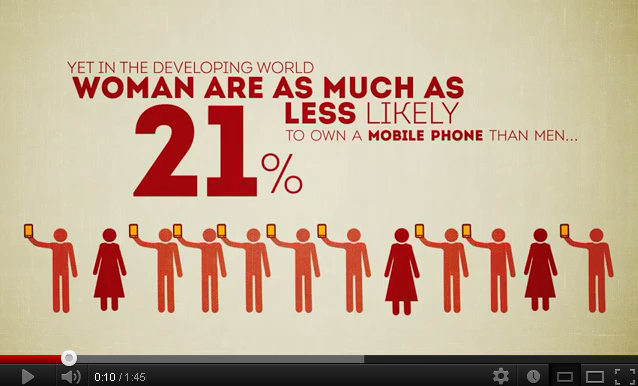
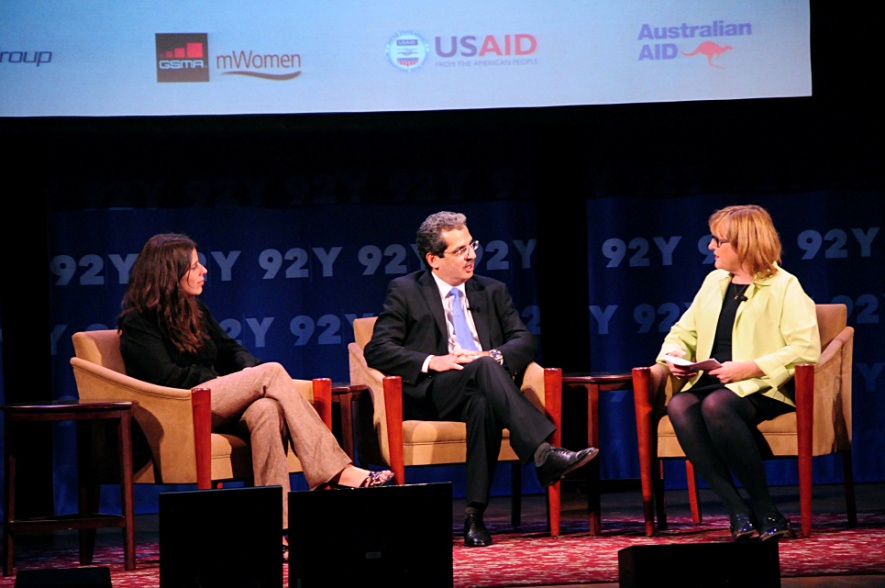
** On Sunday, September 23rd at the Social Good Summit<http://mashable.com/sgs/>in New York, USAID Chief Innovation Officer Maura O’Neill joined partners from GSMA, Qtel Group, AusAID and the design firm Huge to launch<http://www.usaid.gov/news-information/press-releases/usaid-qtel-ausaid-and-gsma-launch-gsma-mwomen-design-challenge>the *GSMA mWomen Design Challenge: Redefining the User Experience*. The Design Challenge <http://designchallenge.mwomen.org/> aims to attract interest from the global design and developer communities to come up with a more intuitive mobile user experience for illiterate populations, particularly women.**** ** ** ** <http://www.youtube.com/watch?v=IFodJOSqr5c>**The event began with a brief video <http://www.youtube.com/watch?v=IFodJOSqr5c> (click image on the left) highlighting the key challenges women face in accessing and owning mobile phones. It was followed by a live demo that showcased how mobile ‘launchers’ can be made more intuitive to meet a variety of needs. Then, Maura had a brief conversation with Qtel Group CEO Dr. Nasser Marafih and Huge Partner of User Experience, Michal Pasternak, to discuss the opportunities surrounding this Challenge. Dr. Nasser emphasized Qtel’s work in Iraq and Indonesia in expanding mobile ownership among women. You can view the entire event here<http://mobilenepal.net/news/gsma-mwomen-design-challenge-launch-redefining-user-experience>(run time 24:16). **** ** **
From our work through the GSMA mWomen Global Development Alliance<http://www.mwomen.org/News/usaid-ausaid-gsma-and-visa-partner-in-gsma-mwomen-programme-global-development-alliance>, we know that mobile phone use in the developing world is exploding, yet women risk being left behind. 21% fewer women than men own a mobile phone in low- to middle-income countries. We also know based on our research<http://www.mwomen.org/Research/striving-surviving-exploring-the-lives-of-women-at-the-base-of-the-pyramid>that technical literacy skills, limited understanding of full mobile potential, cultural barriers, cost of handsets and limitations in electrical power prevent women from fully accessing and owning mobile phones. In fact, 22% of resource-poor women who did not want a mobile phone said it was because they ‘wouldn’t know how to use it.’ We hope to eliminate this barrier, in part, through the Design Challenge.****
** ** ** ** Consider, for a moment, having limited reading and technical literacy skills and picking up a smartphone to locate the camera icon – assuming you were familiar with what the icon looked like. You might be able to take a few pictures, but if you’ve had no experience navigating the mobile device, you may grow frustrated trying to find where the photos were saved, or how they can be shared. What if there was a more intuitive way of performing these actions? Now, extrapolate this example to any number of useful functions on the phone – for educational opportunities, to find jobs, or to seek healthcare. If you cannot use the phone, you will have a difficult time taking advantage of these services. Make the user experience easier, and you open up a multitude of possibilities. **** ** ** Today, developing markets rely on feature phones, or standard mobile phones with basic functionality (largely voice and SMS). Smartphones, however, are growing in scale and market share in developing countries; their price points are lowering and they will soon become the main way people in these regions will access the internet and its associated benefits. As such, this Challenge is prioritizing smartphones – and, in particular, those using the Android operating system – as the phone of the near future. As of June 2012, for example, Android represented 47% of developers’ primary platform in Africa. **** ** ** ****Individuals and organizations are invited to submit their ideas through *December 14, 2012*. A panel of expert judges will evaluate each submission. Winners will be announced in February 2013 at Mobile World Congress in Barcelona:**** ** ** **· ***Grand prize winner*: The winning entry will receive US$20,000 and a meeting with potential investors to discuss options for commercializing the concept.**** **· ***2nd place winner*: The 2nd place entry will receive US$10,000.**** **· ***Emerging talent winner*: This award will be reserved to an entry from an individual entrepreneur or academic institutions in a low- or middle-income country. The winner will receive US$10,000.**** ** ** Attached is a fact sheet that details the Design Challenge in more specificity. Further information<http://blog.usaid.gov/2012/09/building-a-better-user-experience-the-mobile-chapter/>can be found on USAID’s IMPACTBlog<http://blog.usaid.gov/2012/09/designing-smartphones-for-resource-poor-women/> .**** ** ** We encourage you to share this message with your colleagues, particularly those at the Mission and field levels, and ask that they pass the announcement on to local designers and developers. We are hopeful that this Challenge will receive a wide and creative range of submissions.**** ** ** Many thanks, Chris**** ** ** *Christopher Burns * *Economic Growth & Agricultural Development Advisor* *U.S. Agency for International Development (USAID)* *Office of Gender Equality and Women’s Empowerment* *1300 Pennsylvania Avenue, NW 20523***** Tel. 202-712-0226 | chburns@usaid.gov **** ** ** [image: Description: Description: Description: GenDev Signature]**** Intranet <http://inside.usaid.gov/EGAT/off-wid/index.html> | External<http://www.usaid.gov/our_work/cross-cutting_programs/wid/> **** ** **