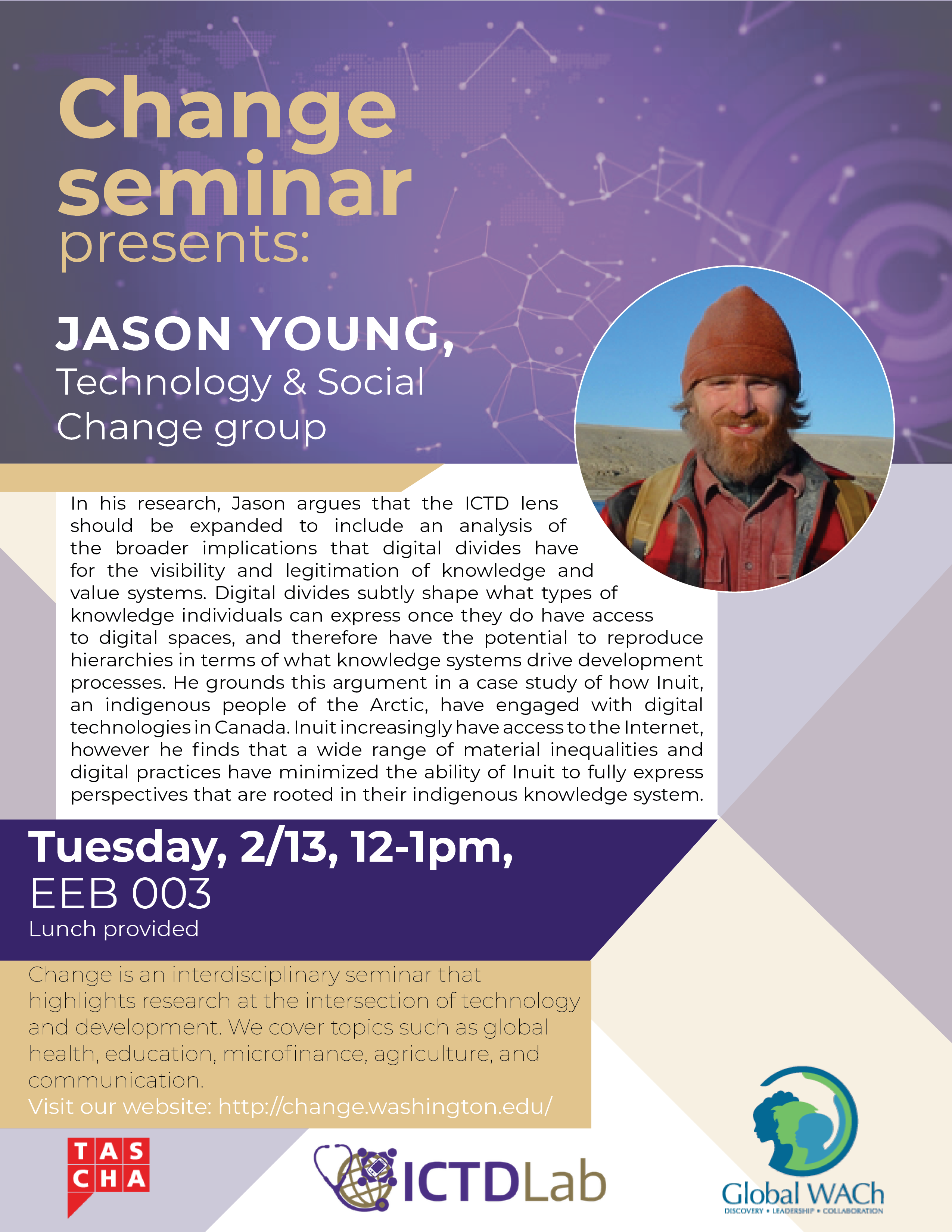
Thanks to everyone who made it to Maria Garrido's talk last week! This week we're welcoming another TASCHA researcher to speak about Environmental Change, Indigeneity, and Technology Use in the Arctic. *Who: *Jason Young, UW Technology & Social Change Group (TASCHA) *What: **Knowledge Politics Across Digital Divides: Environmental Change, Indigeneity, and Technology Use in the Arctic * *When:* Tuesday, Feb 13th, 12-1pm, lunch provided *Where:* ****EEB 003**** *Abstract:* Scholarly excitement around ICTD projects has long been tempered by the recognition that digital divides prevent the effects of technologies from being equal for all peoples or across all places. The material infrastructures and educational requirements of these technologies often intersect with pre-existing political and socio-economic histories to reproduce inequality. The unit of analysis for most of this work has been the individual or the community, asking how digital divides shape *who *has access to technological empowerment. I argue that this lens should be expanded to include an analysis of the broader implications that digital divides have for the visibility and legitimation of knowledge and value systems. Digital divides subtly shape *what types of knowledge* individuals can express once they do have access to digital spaces, and therefore have the potential to reproduce hierarchies in terms of what knowledge systems drive development processes. I ground this argument in a case study of how Inuit, an indigenous people of the Arctic, have engaged with digital technologies in Canada. Inuit increasingly have access to the Internet, and have used that access to push for increased representation of their views within discussions of environmental management. However, I find that a wide range of material inequalities and digital practices have minimized the ability of Inuit to fully express perspectives that are rooted in their indigenous knowledge system. To make their claims heard within digital spaces, they must instead translate their knowledge to fit within Western framings of the environment. These assimilatory processes not only reproduce colonial representations of the Arctic within digital spaces, but also reinforce colonial hierarchies within broader processes of environmental management and Arctic governance. Findings from this research have important implications for understanding the potentials and limitations of digital technologies for supporting the co-production of knowledge across different epistemological systems. *Bio:* Jason Young is a Senior Research Scientist at the Technology & Social Change Group (TASCHA) of the University of Washington’s Information School. He is a human geographer that uses innovative combinations of computational analysis and traditional, qualitative methodologies to answer questions about the cultural and epistemological limits of emerging digital technologies. Specifically, his research focuses on how varied communities use technologies, from geographic information systems (GIS) to social media platforms, to increase the role of local knowledge in political processes. In the past Jason has worked with indigenous communities in the Peruvian Amazon and Canadian Arctic to understand the role of these technologies in advancing indigenous environmental politics. At TASCHA he has expanded his focus to understand the role of libraries in supporting local knowledge generation and access to digital tools, with a focus on Sub-Saharan Africa. Jason also has strong interests in participatory and mixed methods approaches, geospatial analysis, and geovisualization. He holds a Ph.D in Geography from the University of Washington. [image: Inline image 1]